
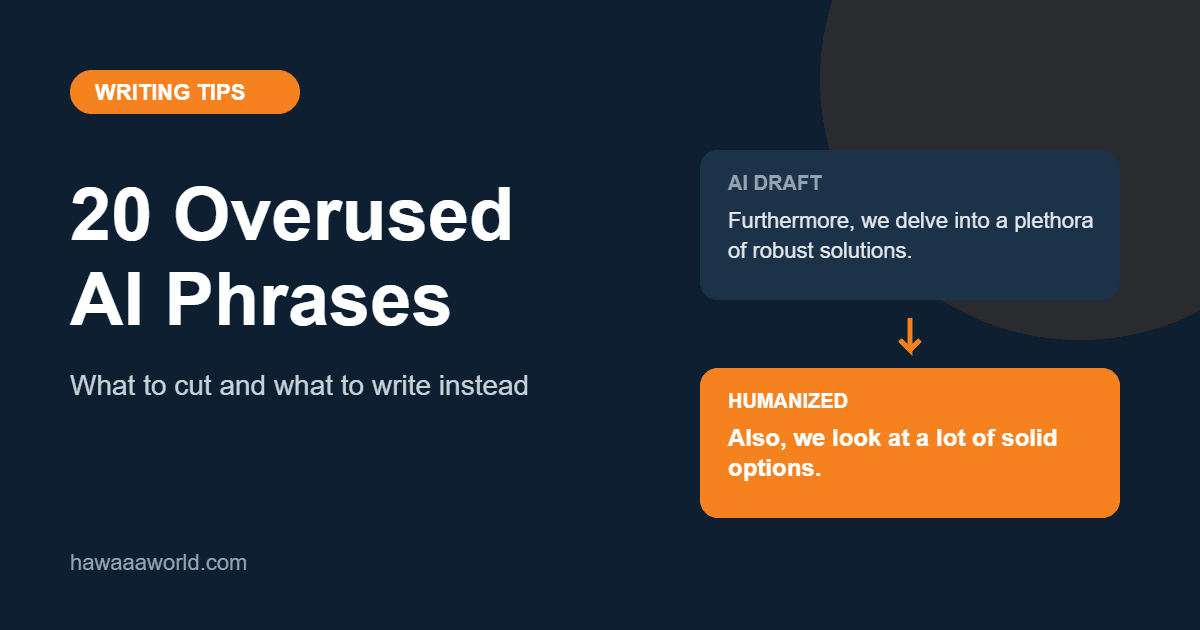
Once you have read enough AI-generated text, certain phrases start to jump off the page. They are not wrong, exactly. They are just worn smooth from overuse, and a reader who sees three of them in one paragraph will quietly decide the whole piece was produced on autopilot. If you want to humanize AI text, hunting down these phrases is the best place to start.
Why These Phrases Appear So Often
Language models learn from enormous amounts of writing, and they favor the patterns that appear most often. Safe, formal, all-purpose phrasing is exactly that kind of pattern, so it keeps coming back. Human writers have a voice and a point of view that makes their word choices less predictable. Your job in editing is to put that unpredictability back.
The Openers and Transitions
These phrases start sentences without saying anything. Cutting them is almost always free.
- “In today’s fast-paced world” – delete it, or write “These days” if you need a time frame.
- “It is important to note that” – just state the point.
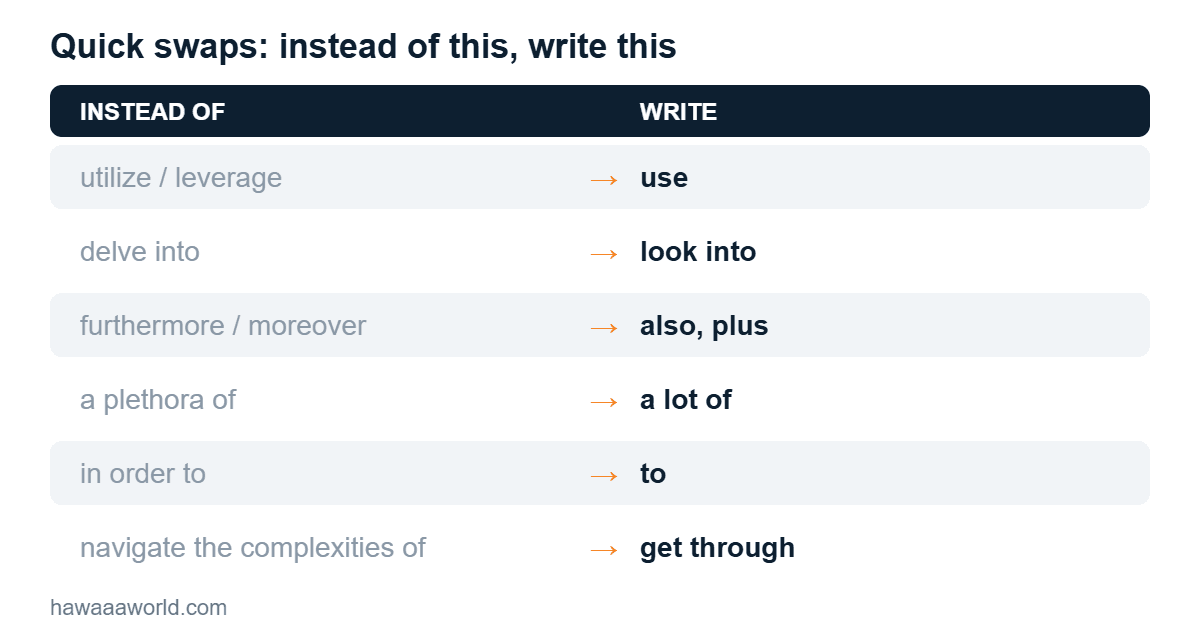
- “Furthermore” and “Moreover” – use “Also”, “Plus” or simply start a new sentence.
- “However,” – try “But” or “Still” for a more natural turn.
- “In conclusion” – write “To sum up”, or better, end with a next step.
The Inflated Verbs and Nouns
These words make simple ideas sound heavier than they are.
- Utilize / leverage – use.
- Facilitate – help, or make easier.
- Delve into – look into, dig into.
- A plethora of / a myriad of – many, a lot of.
- Commence – start, begin.
- Prior to – before.
- In order to – to.
The Hype Adjectives
Adjectives like these promise a lot and prove nothing.
- Robust – say what makes it strong: fast, secure, easy to maintain.
- Seamless – say what is smooth about it.
- Cutting-edge / state-of-the-art – name the actual feature.
- Game-changer – describe the change, with a number if you have one.
- Comprehensive – list what is covered instead.
- Crucial / pivotal – “key” or “important” is plenty.
Stock Metaphors
Phrases like “navigate the complexities of”, “unlock the potential of” and “embark on a journey” are the ones readers recognize instantly. Replace each with a plain verb. “Navigate the complexities of tax season” becomes “get through tax season”. It is shorter and it sounds like you.
A Fast Way to Clean Them Up
You can search a draft for these phrases by hand, but it is tedious on long text. The free Humanize AI Text tool on Hawaa Hub already knows most of the phrases above and swaps them for plainer wording, then adds contractions so the result reads more like speech. Paste your text, pick a mode and review the output. In Basic mode it makes light, predictable swaps, while Advanced and Ultra also reshape sentence length.
A few honest limits: it works on English text, it handles up to 1,000 words at a time, and it is a phrase-and-rhythm editor, not a rewriter. It will not add your own examples, and nobody can promise how an AI detector will react to any given text. Use it to save time on the mechanical clean-up, then spend your energy on the parts only you can write.
Do a Final Human Pass
After the automatic clean-up, read the piece aloud. Add one concrete detail from your own experience, trim any sentence that repeats an earlier one and rewrite the ending in your own words. If you want a second opinion on tone, our AI content detector gives a rough signal, and the word counter helps you keep the length in check.
Keep Your Own List
Every writer has their own pet phrases, and every client or brand has words it never uses. As you edit, keep a running list of the phrases you cut most often. Over time, you will spot them before they reach the page. For more tools that make writing and publishing easier, see the full collection of free online tools.